
W. Lee, K. Jensen
MIT, MA, USA
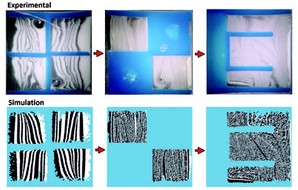
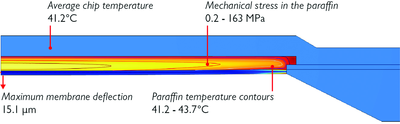
The chemical reactions used to generate solvents and certain pharmaceuticals rely on organic synthesis, a process of combining individual chemicals that can be accelerated through microwave heating. A microreactor system facilitates the direct, localized, and efficient temperature change necessary for successful synthesis. However, a uniform temperature distribution is crucial to the chemical process, and these reactions can be inhibited by unwanted temperature changes or heating that occurs too slowly. Wen-Hsuan Lee, a researcher at the Massachusetts Institute of Technology (MIT), fabricated a borosilicate glass microreactor to conduct this microwave organic synthesis, but when she tested her design in a microwave system, she discovered that the heating was uneven and below the desired temperature. Using COMSOL Multiphysics, she modeled the microreactor to investigate the effects of its geometry and orientation on the heating process. From her simulation results, she was able to redesign the microreactor and optimize its location and orientation in the microwave system to achieve successful organic synthesis.
Suggested Stories
Modeling of Laminar Flow Static Mixers
Veryst Engineering, a company that provides consulting in engineering design and product manufacturing, has ...

Lightning-Proof Wind Turbines
Søren Find Madsen, Global Lightning Protection Services A/S, Lejre, Denmark Global Lightning Protection Services A ...
Optimizing Instrument Transformers and Sensors with Multiphysics Simulation
Power grids need to be properly maintained in order to protect them from system failure. Engineers at ABB use ...
Actuation Technique for Miniature Robots Developed using Multiphysics Simulation
Robotic devices for minimally invasive surgery procedures require flexible tools and careful actuation. But most ...


