
Tommi Paananen, David Geibel, Bill Teising, Mårten Almkvist, Jon Brasher, Josh Elder, Bob Elick and Chris Whitten
ABB Alamo
Tennessee
Consumers of power rely on fairly stable voltages. Transformers contain tap changers which vary the ratio of secondary to primary turns by switching the point at which either the input or output circuits are connected. Changing this ratio enables stepped voltage regulation of the output. As the world moves toward the modernized smart grid, the tap changer’s design must be altered to make it smart grid-ready.
ABB Alamo in Tennessee, a transformer components expert, took on this challenge. The biggest problem they faced was creating a design of the insulation for the tap changer which would have to withstand the stress of thousands of volts. The dielectric materials can fail in two ways: breakdown through the material and breakdown across the surface.
To address this dielectric stress problem, ABB built a model of the geometry and imported it into COMSOL Multiphysics using LiveLink™ for Creo™ Parametric. They were then able to adjust the geometry of the large CAD assemblies and synchronize the corresponding geometry in COMSOL to generate a high-quality mesh for large-scale batch simulation. Using COMSOL, ABB was able to develop tap changers based on actual field conditions.
Suggested Stories
Magnetic Transmissions Increase Lifespan of Offshore Wind Farms
Sintex is a developer and manufacturer of magnetic couplings, systems that transmit torque and power with ...
Identifying the Root Cause of Electronics Failures with Simulation Apps
The Centre for Electronic Corrosion (CELCORR) research group at the Technical University of Denmark predicts ...
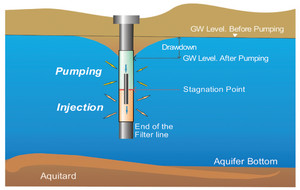
Pumping and Injecting from a Single Borehole
Professor Dr. Martin Sauter leads a group at the University of Göttingen in research on hydrogeology. Cooperating with ...

Designing Tidal Turbines That Are Safe for Marine Life
A guest blogger from Xi Engineering discusses how his organization is using acoustics simulation to study the impacts ...


