
K. Suthar, C. Benmore
Argonne, IL, USA
As part of an industry that saves lives on a regular basis, pharmaceutical companies are in need of systems that can be used to deliver high-quality medicines. One method utilizes sound waves generated by an acoustic levitator with foam-coated transducers. Using the acoustic force from the sound waves, chemical particles are suspended between the transducers, where they can be mixed in a contaminant-free space.
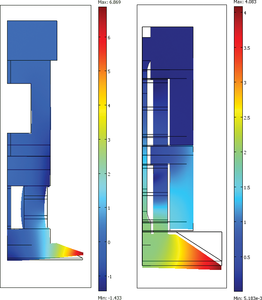
Using COMSOL Multiphysics, Kamlesh Suthar and Chris Benmore of Argonne National Laboratory have simulated an acoustic levitator in order to find the best geometry for controlling how liquid droplets form between the transducers. They also investigated the changes in viscosity and surface tension and the effects that such parameters have on the droplet shapes. Studying the fluid-structure interaction (FSI), Suthar explored the sound pressure levels, material properties, and geometry options for the levitator. Simulating the acoustic levitator helped them to hone their design and achieve a new degree of control over the interactions between droplets, which will ultimately contribute to life-saving advancements for pharmaceuticals.
Suggested Stories
Making Smart Materials Smarter with Multiphysics Simulation
Smart materials with magnetostrictive behavior are engineered and incorporated in high-precision devices by the ...
Improving Gas Pipeline Squeeze-Off Standards with Numerical Simulation
Gas Technology Institute (GTI), a leader in natural gas research, development, and training, investigated industry ...
Illuminating Complex Material Behavior with Multiphysics Simulation
At Canadian Nuclear Laboratories, multiphysics simulation is used to gain insight into the behavior of nuclear fuel ...
Control of Joule Heating Extends Performance and Device Life
Large electrical systems carrying high currents could pose a danger if any of their components, such as fuses and bus ...


