
K. Suthar, C. Benmore
Argonne, IL, USA
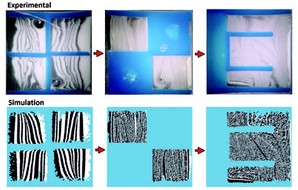
As part of an industry that saves lives on a regular basis, pharmaceutical companies are in need of systems that can be used to deliver high-quality medicines. One method utilizes sound waves generated by an acoustic levitator with foam-coated transducers. Using the acoustic force from the sound waves, chemical particles are suspended between the transducers, where they can be mixed in a contaminant-free space.
Using COMSOL Multiphysics, Kamlesh Suthar and Chris Benmore of Argonne National Laboratory have simulated an acoustic levitator in order to find the best geometry for controlling how liquid droplets form between the transducers. They also investigated the changes in viscosity and surface tension and the effects that such parameters have on the droplet shapes. Studying the fluid-structure interaction (FSI), Suthar explored the sound pressure levels, material properties, and geometry options for the levitator. Simulating the acoustic levitator helped them to hone their design and achieve a new degree of control over the interactions between droplets, which will ultimately contribute to life-saving advancements for pharmaceuticals.
Suggested Stories
Driving EV Development with a Twin-Battery Approach
IAV developed an approach for combining sodium-ion and solid-state lithium iron phosphate battery technologies to form ...
Modeling of Laminar Flow Static Mixers
Veryst Engineering, a company that provides consulting in engineering design and product manufacturing, has ...

Sonos Optimizes MEMS Microphone Design to Reduce Distortion from Wind Noise
Let's examine how Sonos has used simulation software to reduce the distortion caused by wind noise on their MEMS ...
Powering Offshore Wind Farms with Numerical Modeling of Subsea Cables
Hellenic Cables uses finite element modeling to analyze and validate underground and subsea cable designs for use in ...


