
NEXT ENERGY Analyzes Heat Transfer in Lithium-Ion Batteries
Gerd Liebig, Pamina Bohn, NEXT ENERGY EWE Research Centre for Energy Technology, Germany
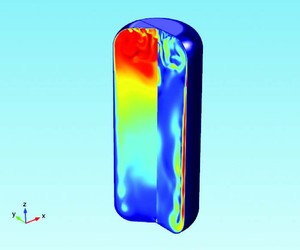
Lithium-ion batteries, which have a tendency to degrade at high temperatures, must adhere to stringent regulations guaranteeing their ability to withstand operating temperature fluctuations. Researchers at NEXT ENERGY used heat transfer modeling to study whether high welding temperatures can create enough temperature propagation within cells to cause irreversible damage, such as electrolyte decomposition and capacity loss. They discovered that tab welding can, in fact, induce irreversible damage, but laser welding is significantly less detrimental.
Suggested Stories
Modeling Helps Improve Safety in the Production of Teflon
BAM German Federal Institute for Materials Research & Testing in Berlin promotes industrial development by ...
Life Sciences Company Accelerates Biopharmaceutical R&D with a Dedicated CAE Department
Biopharmaceuticals are expensive to develop due to their complex molecular structure, the specialized manufacturing ...
Optimizing Instrument Transformers and Sensors with Multiphysics Simulation
Power grids need to be properly maintained in order to protect them from system failure. Engineers at ABB use ...
Optimizing the Performance of Complex Building Façades
Engineers at Newtecnic specialize in complex building design, working with bold and fluid architectural shapes. To ...


