
M. Bachmann, V. Avilov, A. Gumenyuk, and M. Rethmeier
BAM Federal Institute For Materials Research and Testing
Germany
High-power laser beam welding uses a localized heat source to achieve narrow deep welds and high welding rates. Engineers run into some difficulties because the use of a localized heat source often results in the distortion of metal components; spattering and the ejection of droplets from the weld pool results in underfills, undercuts, craters, blowholes, or blowouts.
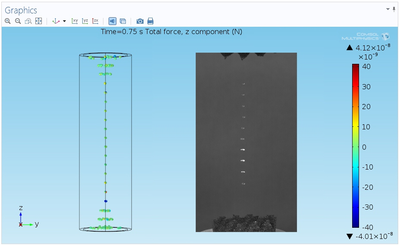
A stationary magnetic field is applied to the laser welding process to improve its quality and counteract effects such as spattering. BAM Federal Institute For Materials Research and Testing in Germany are working to improve the quality of high-power laser beam welding using COMSOL Multiphysics. To model and simulate the laser beam welding, heat transfer, fluid dynamics, and electromagnetics were coupled and solved. This allowed BAM to accurately model the process by including Marangoni effects, gravity, latent heats of fusion, and Lorentz forces.
Suggested Stories
On the Cutting Edge of Hearing Aid Research
Nearly 20% of the United States population has some degree of hearing impairment. Despite the relative ...
Efficient Grid Operation and Maintenance with Simulation Apps
Engineers at NARI Group Corporation developed the Cable Condition Analysis Expert System App, based on their ...

A Practical Implementation of Multiphysics Topology Optimization
A guest blogger from GN Audio A/S introduces a multiphysics topology framework developed with the COMSOL Application ...
Floating on Sound Waves with Acoustic Levitation
As part of an industry that saves lives on a regular basis, pharmaceutical companies are in need of systems that can ...


