
M. Bachmann, V. Avilov, A. Gumenyuk, and M. Rethmeier
BAM Federal Institute For Materials Research and Testing
Germany
High-power laser beam welding uses a localized heat source to achieve narrow deep welds and high welding rates. Engineers run into some difficulties because the use of a localized heat source often results in the distortion of metal components; spattering and the ejection of droplets from the weld pool results in underfills, undercuts, craters, blowholes, or blowouts.
A stationary magnetic field is applied to the laser welding process to improve its quality and counteract effects such as spattering. BAM Federal Institute For Materials Research and Testing in Germany are working to improve the quality of high-power laser beam welding using COMSOL Multiphysics. To model and simulate the laser beam welding, heat transfer, fluid dynamics, and electromagnetics were coupled and solved. This allowed BAM to accurately model the process by including Marangoni effects, gravity, latent heats of fusion, and Lorentz forces.
Suggested Stories

Modeling Acoustical Properties of Porous Media in COMSOL®
A guest blogger from the University of Sheffield introduces the Johnson–Champoux–Allard–Lafarge (JCAL) model for ...
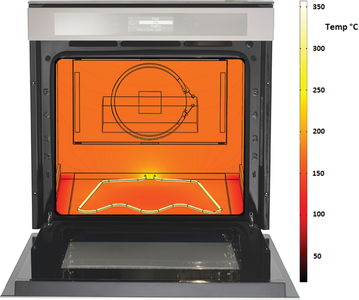
Simulation Turns Up the Heat and Energy Efficiency at Whirlpool Corporation
Engineers working on a joint research project between Whirlpool Corporation and the European initiative GREENKITCHEN ...
Investigating Intrabody Communication for Leadless Cardiac Pacemakers
MicroPort CRM used numerical simulation to optimize leadless cardiac pacemaker (LCP) designs and how they communicate ...

Designing the Sound Absorption of Microlattice Structures
Using numerical simulation, you can design microlattice structures with sound-absorbing properties, and then print ...


