
KAPL Analyzes CO2 Foil Thrust Bearing Characteristics with Simulation
Treevor Munroe
Knolls Atomic Power Laboratory, Niskayuna, NY
Knolls Atomic Power Laboratory (KAPL) is a research and development facility supporting the United States Naval Nuclear Propulsion Program. KAPL recently collaborated with Bettis Atomic Power Laboratory to test a supercritical carbon dioxide (S-CO2) Brayton power cycle system.
The system was designed to operate at high speed and high gas pressure, which means the turbine shaft bearings must withstand a wide range of radial and axial loads. The thrust bearings used to constrain the axial forces, however, showed extensive wear at certain speeds.
Using COMSOL Multiphysics, KAPL was able to analyze the structural mechanics, fluid mechanics, and heat transfer of the Brayton power cycle system to better understand the operation and deterioration of the thrust bearings. This allowed them to optimize geometry and to improve bearing performance.
Suggested Stories
Lightweighting with Aluminum: Corrosion Apps Guide Leading Design
To achieve fuel efficiency goals, conventional materials for car structures, such as structural steel, must be ...

Finding Buried Objects Using Seismic Surface Waves
Could spectral analysis of seismic surface waves help find a buried object? Learn about this novel method here.
A STEP in the Right Direction: Modeling AC Losses in a Tokamak Design
The Spherical Tokamak for Energy Production (STEP) program aims to deliver a prototype fusion energy plant in the ...
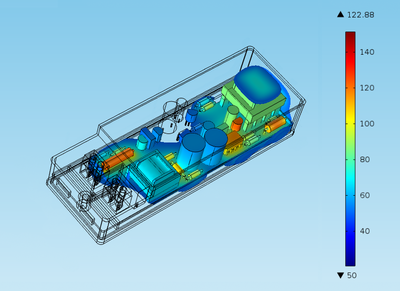
Keeping LEDs Cool Gets More Manageable Through Simulation
Light-emitting diodes (LEDs) offer many benefits over incandescent lighting, such as long life spans and high luminous ...


