
Clemson Simulates Electrode Setup for Dielectrophoresis
G. Zhang
Clemson U, SC, USA
J. Brcka, J. Faguet, E. Lee
Tokyo Electron, TX, USA
Dielectrophoresis (DEP) is a method of patterning cells and particles used in medical, electronics, and energy applications. When an electric field is applied to an array of cells or dielectric particles suspended in a medium, they become polarized, causing movement that reorganizes the particles. This is an efficient way to assemble materials layer by layer at the nanoscale, and is sometimes used in mass production of materials. Through a partnership between Clemson University and Tokyo Electron U.S. Holdings, Inc., researchers are analyzing unexpected particle rotation and alignments they have observed during cell patterning. They have used COMSOL Multiphysics models to understand cell patterns and material assembly; their simulations account for nonhomogeneous cell properties and electric field distortions, which they are analyzing to predict the influence of DEP force on this behavior.
Suggested Stories
Making Predictions in Additive Manufacturing with Simulation Apps
Engineers at the Industrial Technology Research Institute (ITRI) can predict the performance of laser powder bed ...
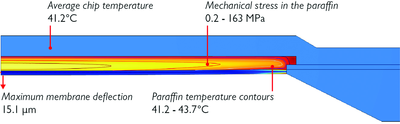
Actuation Technique for Miniature Robots Developed using Multiphysics Simulation
Robotic devices for minimally invasive surgery procedures require flexible tools and careful actuation. But most ...
Upgrading the Nuts and Bolts of the Electrical Grid for a New Generation
Migrating the electrical grid to a “smart grid” is usually discussed in terms of IT issues or embedded systems. Yet, ...
Identifying the Root Cause of Electronics Failures with Simulation Apps
The Centre for Electronic Corrosion (CELCORR) research group at the Technical University of Denmark predicts ...


