
Researchers in Germany Simulate Corrosion Protection for Submarines
David Schaefer
University of Duisburg-Essen, Duisburg, Germany
Germany's Technical Center for Ships and Naval Weapons, Bundeswehr, Germany
Submarines create underwater electric potential (UEP) signatures when using corrosion protection systems. These signatures are detectable by enemy vessels, an undesirable effect of the corrosion protection. Germany’s Technical Center for Ships and Naval Weapons (WTD 71) has worked with the Laboratory for General and Theoretical Electrical Engineering (ATE) at the University of Duisburg-Essen to research these UEP signatures in order to reduce them.
Using COMSOL, the team simulated the electric potential distribution on the hull of a submarine, indicating whether or not the material is protected from corrosion. The higher the electric potential, the more the hull is protected. After this, they modeled the signature left by the different electric potentials. The general notion was that a higher amount of corrosion leads to a more detectable signal, which is mostly true. Furthermore, the results showed that the signature is actually the least detectable between zero corrosion protection and the standard operating conditions for full corrosion protection.
Suggested Stories

New Method for Performing Topology Optimization of FSI Problems
Many topology optimization methods are only available for FSI problems within a purely academic scope. Enter the TOBS ...
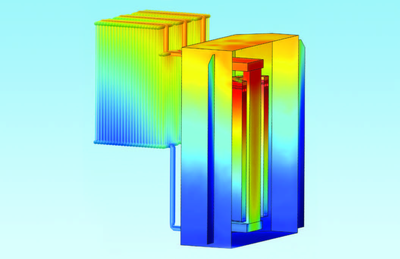
Simulation Enables the Next Generation of Power Transformers and Shunt Reactors
From power generation to its distribution to end users, power transformers and shunt reactors are used throughout the ...
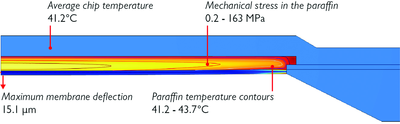
Actuation Technique for Miniature Robots Developed using Multiphysics Simulation
Robotic devices for minimally invasive surgery procedures require flexible tools and careful actuation. But most ...
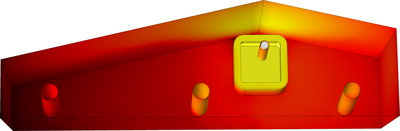
Continuous Casting: Optimizing Both Machine and Process with Simulation
The process of continuous casting has transformed steel production, saving valuable resources while improving steel ...


