
Marco Barink, Erica Coenen, TNO, Netherlands
The advantages of anisotropic properties in 3D printing materials have been difficult to exploit for product design, limited by material manufacturing and production methods. However, additive manufacturing is opening doors to material fabrication, allowing engineers to virtually design varying material properties into a single product. At the Netherlands Organization for Applied Scientific Research (TNO), researchers investigated virtual material design using multiphysics simulation and multiscale modeling.
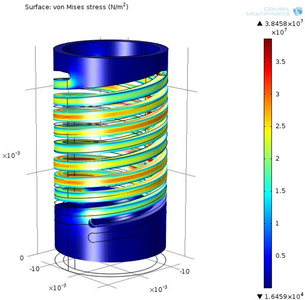
To develop a procedure for designing anisotropy into 3D-printed structures, the researchers used COMSOL Multiphysics to study mechanical behavior in a unit cell, control material properties and the orientation of anisotropic fibers, and optimize local material distribution to achieve desired overall properties. To study material design on a larger scale, they extracted material parameters from the unit cell to include in a model of a full-scale 3D-printed object, and successfully applied methods of fully-coupled multiscale modeling to geometry and material design in several different applications.
Suggested Stories
Meeting High-Speed Communications Energy Demands Through Simulation
The information and communication technology industry needs new energy-efficient devices that can keep up with the ...
Prototyping Antennas for Mobile Recording of TV Sports Events with Simulation
Researchers at Radiotelevisione Italiana (RAI) are optimizing circularly polarized antenna designs for recording live ...

Opening the Path to Commercial Fusion Energy with Simulation
CFS has showcased the potential of high-temperature superconductor magnets and high-field tokamaks for fusion ...
Keynote: Electromagnetic-Based Hyperthermia Therapy for Treatment of Brain Cancer
This keynote talk from the COMSOL Conference 2024 Boston explores how Dr. Dario Rodrigues from the University of ...


