
In accordance with our Quality Policy, COMSOL maintains a library of hundreds of documented model examples that are regularly tested against the latest version of the COMSOL Multiphysics® software, including benchmark problems from ASME and NAFEMS, as well as TEAM problems.
Our Verification and Validation (V&V) test suite provides consistently accurate solutions that are compared against analytical results and established benchmark data. The documented models below are part of the COMSOL Multiphysics® software’s built-in Application Libraries. They include reference values and sources for a wide range of benchmarks, as well as step-by-step instructions to reproduce the expected results on your own computer. You can use these models not only to document your software quality assurance (SQA) and numerical code verification (NCV) efforts, but also as part of an in-house training program.
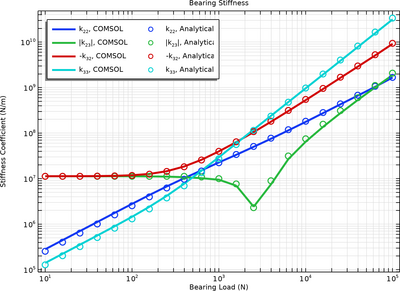
When analyzing rotors, it is common that bearings are modeled through their effective dynamic coefficients about a static equilibrium position. This model illustrates how to compute such coefficients for a cylindrical journal bearing. The bearing length is kept much smaller than its ... Read More
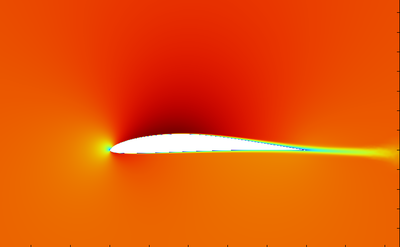
The flow around the Eppler 387 airfoil is computed with the SST turbulence model both with and without the transition model. The reuslts are compared with experimental values. Read More
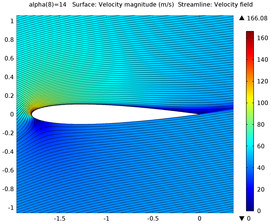
This model simulates the flow around an inclined NACA 0012 airfoil at different angles of attack using the SST turbulence model. The results show good agreement with the experimental lift data of Ladson and the pressure data of Gregory and O’Reilly. Read More
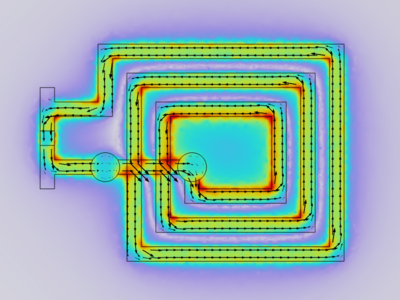
This tutorial example shows how to use the Electric Currents in Shells interface together with Magnetic Field interface to compute the resistance and inductance of a planar PCB coil in the stationary regime. Read More
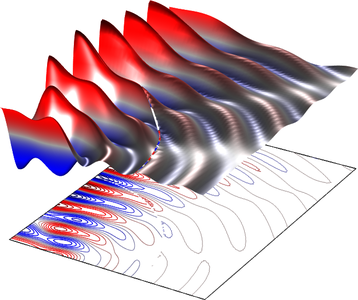
An axisymmetric model of a rigid piston in an infinite baffle is used to exemplify the Exterior Field Calculation feature of the Acoustics Module. The radiation results provided by the COMSOL Multiphysics® software are compared to analytical results for the on-axis radiation ... Read More
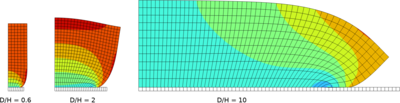
Polymer hydrogels consist of a crosslinked network of long-chained polymers that has imbibed a large number of solvent molecules. Such materials are used in many biomedical applications, such as targeted drug delivery, tissue engineering, and stimuli-sensitive actuators. This benchmark ... Read More
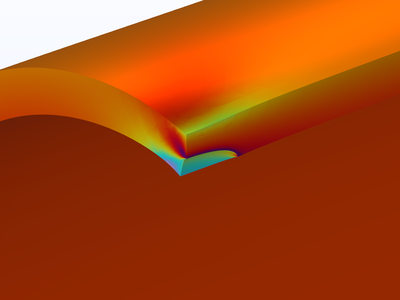
In this benchmark example, a semi-elliptical crack at the inner surface of a cylinder is studied. The inside of the cylinder and the crack faces are subjected to a pressure load. The J-integral is calculated along the crack front, and the stress intensity factor is then compared with the ... Read More
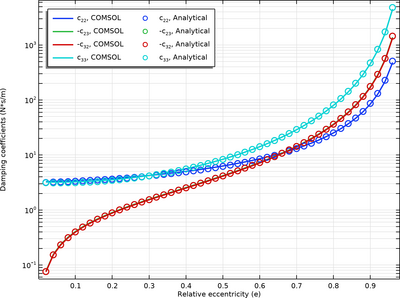
Squeeze film dampers are components that provide additional damping to rotating machines. To simplify the modeling of a rotor assembly, squeeze film dampers are modeled in terms of their damping coefficients which are a functions of the journal location in the damper. This model computes ... Read More
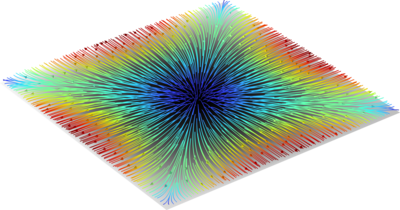
This example describes how to simulate the flow of a thin film of fluid in the gap between two rectangular plates, one of them with a porous facing, when the fluid is squeezed as a consequence of the relative motion between the plates. The model accounts for the ingress and egress of ... Read More

This model is a benchmark for three-phase flow commonly used in food processing, pharmaceutical industry, and chemical processing. The results are validated against data reported in the literature. A gas bubble rises through two layers of liquid, a lighter liquid resting on top of a ... Read More


