
Frequency Response of a Typical Surface Acoustic Wave Delay Line
Application ID: 58871
This tutorial shows how to model an arbitrary surface acoustic wave (SAW) delay line. The design parameters are arbitrary in the sense that the outputs are far from optimal from a practical standpoint. The aim is to show how a SAW device can be set up in the software: how to define the geometry, choose a suitable mesh resolution, define IDTs and exterior open boundaries, what outputs can be extracted, and so on.
The Y- and S-parameters are obtained and validated by comparison with the semi-analytical Delta-Function model. Good agreement is demonstrated.
This tutorial builds on the Surface Acoustic Wave Velocity Calculations from a Unit Cell model, where a large set of useful parameters was obtained, including the wave velocities, the squared effective electromechanical coupling coefficient, and so on.
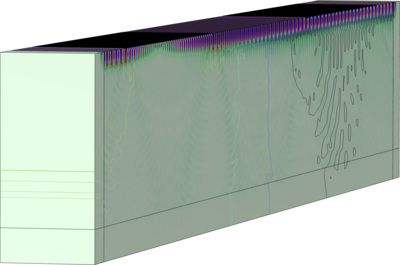
This model example illustrates applications of this type that would nominally be built using the following products:
however, additional products may be required to completely define and model it. Furthermore, this example may also be defined and modeled using components from the following product combinations:
- COMSOL Multiphysics® and
- either the Acoustics Module, MEMS Module, or Structural Mechanics Module and
- either the AC/DC Module, Electric Discharge Module, MEMS Module, Plasma Module, or Semiconductor Module
The combination of COMSOL® products required to model your application depends on several factors and may include boundary conditions, material properties, physics interfaces, and part libraries. Particular functionality may be common to several products. To determine the right combination of products for your modeling needs, review the Specification Chart and make use of a free evaluation license. The COMSOL Sales and Support teams are available for answering any questions you may have regarding this.


