
The Application Gallery features COMSOL Multiphysics® tutorial and demo app files pertinent to the electrical, structural, acoustics, fluid, heat, and chemical disciplines. You can use these examples as a starting point for your own simulation work by downloading the tutorial model or demo app file and its accompanying instructions.
Search for tutorials and apps relevant to your area of expertise via the Quick Search feature. Note that many of the examples featured here can also be accessed via the Application Libraries that are built into the COMSOL Multiphysics® software and available from the File menu.

This presentation shows how to use the Optimization Module to fit a material model curve to experimental data. It is based on the hyperelastic Mooney-Rivlin material model example given in the Structural Mechanics users guide. Read More

This example considers the thermal cracking of acetone, which is a key step in the production of acetic anhydride. The gas phase reaction takes place under nonisothermal conditions in a plug-flow reactor. As the cracking chemistry is endothermic, control over the temperature in the ... Read More
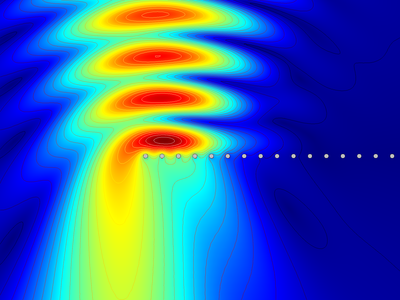
A Gaussian electromagnetic wave is incident on a dense array of very thin wires (or rods). The distance between the rods and, thus, the rod diameter is much smaller than the wavelength. Under these circumstances, the rod array does not function as a diffraction grating (see the Plasmonic ... Read More
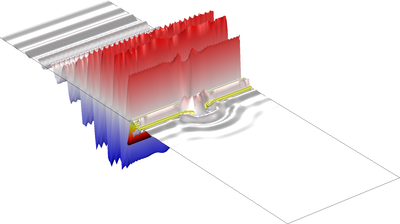
This tutorial shows how to solve the full time-dependent wave equation in dispersive media such as plasmas and semiconductors. The 2D TM in-plane wave model solves for the vector potential from the wave equation and for an auxiliary electric polarization density from an ordinary ... Read More
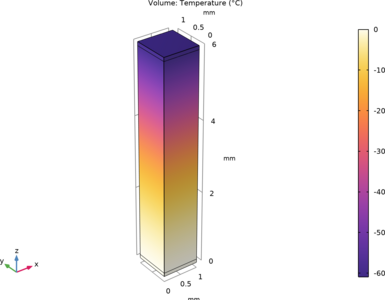
A thermoelectric leg is a fundamental component of a thermoelectric cooler (or heater). For example, a thermocouple is a thermoelectric module typically made of two thermoelectric legs: one made of p-type and of one n-type semiconductor material which are connected in series electrically ... Read More
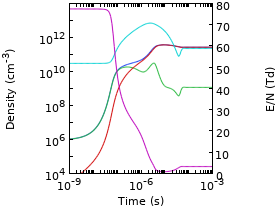
The electron energy distribution function (EEDF) plays an important role in the overall behavior of discharges. In this example, the formation period of an Argon plasma is studied with special attention paid to the EEDF. The plasma is created within a 4 cm gap by a DC source voltage of 1 ... Read More
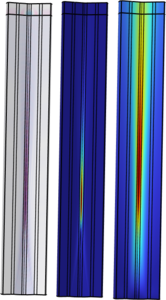
Acoustic streaming, a steady flow induced by sound waves, has been used in biomedical and engineering industrial., Examples include enhancement of convective heat transfer, ultrasonic cleaning, localized micro-mixing, hemolysis of blood cells, and micropumps etc. The phenomenon is ... Read More
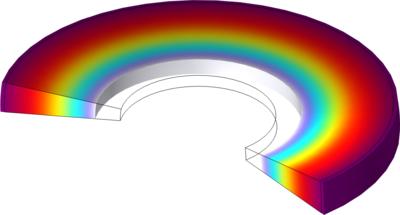
Creep is an inelastic time-dependent deformation which occurs when a material is subjected to stress at sufficiently high temperature, say 40% of the melting point or more. Experimental creep data (using constant stress and temperature) often display three different types of behavior ... Read More
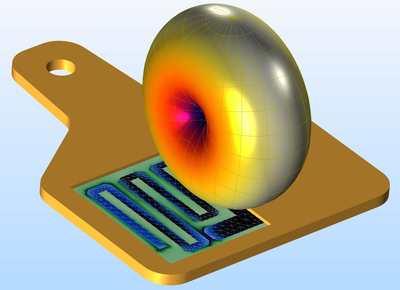
UHF RFID tags are widely used for identifying and tracking animals. This model simulates a passive radio-frequency identification (RFID) tag for the UHF frequency range. With respect to the chip transponder’s complex impedance, a reflection coefficient is computed. This is done using an ... Read More
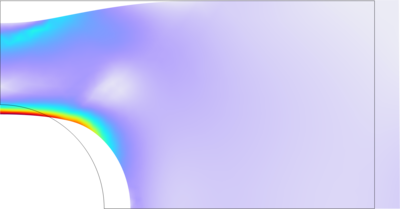
This example shows the analysis of a perforated plate loaded into the plastic regime. Part of the example is a benchmark, which you can find in section 7.10 of The Finite Element Method by O.C. Zienkiewicz. The unloading of the plate and residual stresses are also studied. In a second ... Read More


