
The Application Gallery features COMSOL Multiphysics® tutorial and demo app files pertinent to the electrical, structural, acoustics, fluid, heat, and chemical disciplines. You can use these examples as a starting point for your own simulation work by downloading the tutorial model or demo app file and its accompanying instructions.
Search for tutorials and apps relevant to your area of expertise via the Quick Search feature. Note that many of the examples featured here can also be accessed via the Application Libraries that are built into the COMSOL Multiphysics® software and available from the File menu.
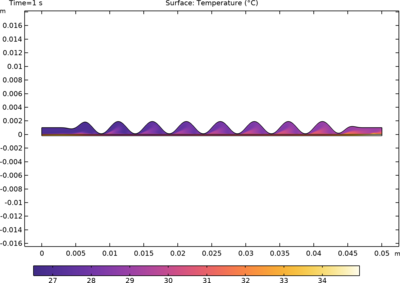
The heat exchanger in this tutorial model contains a dynamic wall with an oscillating wave shape. The deformation induces mixing in the fluid and reduces the formation of thermal boundary layers. Hence, it increases heat transfer between the walls and the fluid. In addition, the wave ... Read More
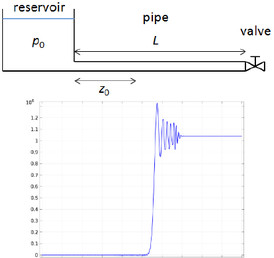
When a valve is closed rapidly in a pipe network it gives rise to a hydraulic transient known as a water hammer. The propagation of these hydraulic transients can in extreme cases cause failures of pipe systems caused by overpressures. This is a model of a simple verification pipe system ... Read More
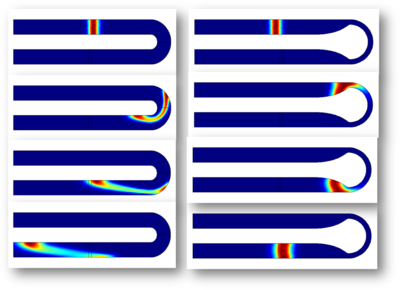
This model studies the dispersion of neutral species band through curved microchannel in an Electroosmotic flow (EOF) . Using Optimization module, geometric optimization is carried out to minimize the curve-induced dispersion.The central idea is to parametrically represent the geometry ... Read More
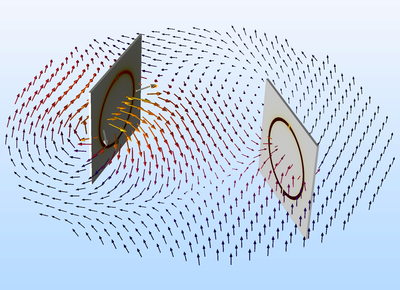
This model addresses the concept of wireless power transfer by studying the energy coupling between two circular loop antennas tuned for UHF RFID frequency whose size is reduced using chip inductors. The circular loop antenna provides inherent inductive coupling by its shape, and it can ... Read More
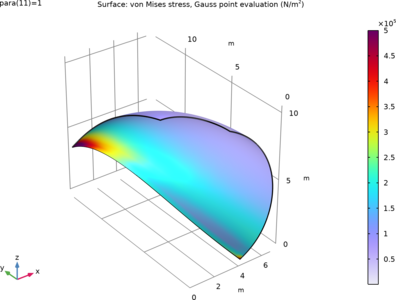
This example studies the deformation of a hemispherical shell, where the loads cause significant geometric nonlinearity. The maximum deflections are more than two magnitudes larger than the thickness of the shell. The problem is a standard benchmark, used for testing shell formulations ... Read More
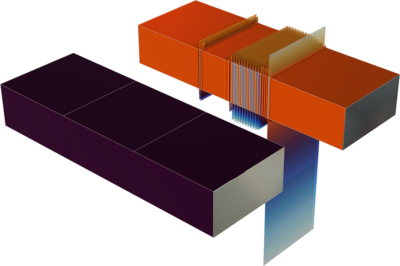
In a diode or a transistor, when a p-n junction is reverse-biased (the p-side is connected to a lower potential than the n-side), ideally, no current should flow. However, due to minority carriers (electrons in the p-side and holes in the n-side), a small current, known as the reverse ... Read More
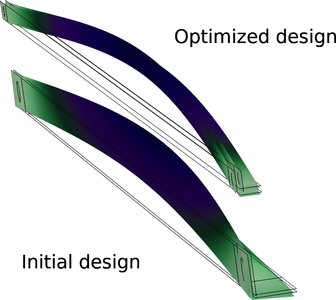
Buckling is a common failure mode for slender structural components. This model shows how the buckling load of a diagonal brace can be maximized, while constraining the volume of the brace. Read More
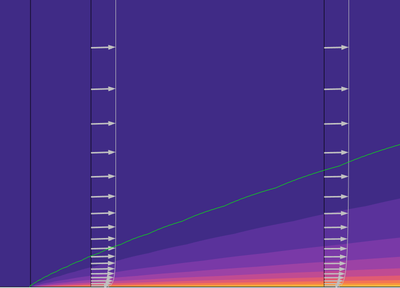
This model is a verification case to attest the behavior of turbulence models and wall functions in the boundary layer of a turbulent flow. The velocity and the temperature are compared to the theoretical curves in a wall-resolved and a wall-modeled approach using the Algebraic y+ ... Read More
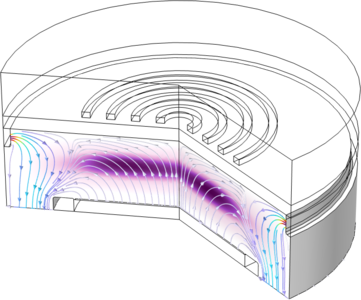
This tutorial studies the etching of silicon using an inductively coupled plasma reactor with an RF bias in a mixture of CF4/O2. The etching rate is computed along the wafer as a function of the RF bias voltage. Read More
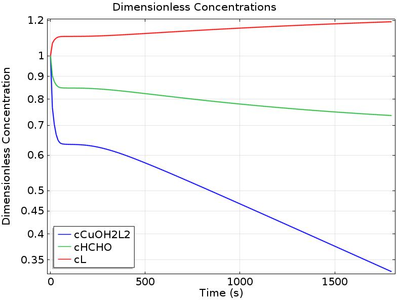
Electroless deposition or plating is a non-galvanic plating method that does not require any external electrical power. This technique is typically used for electroless plating of nickel, silver, gold and copper. In electroless deposition, partial oxidation and reduction reactions ... Read More


