
The Application Gallery features COMSOL Multiphysics® tutorial and demo app files pertinent to the electrical, structural, acoustics, fluid, heat, and chemical disciplines. You can use these examples as a starting point for your own simulation work by downloading the tutorial model or demo app file and its accompanying instructions.
Search for tutorials and apps relevant to your area of expertise via the Quick Search feature. Note that many of the examples featured here can also be accessed via the Application Libraries that are built into the COMSOL Multiphysics® software and available from the File menu.
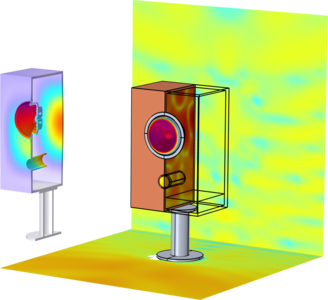
This model shows a full vibroacoustic analysis of a loudspeaker including driver, cabinet, and stand. It lets you apply a nominal driving voltage and extract the resulting sound pressure level in the cabinet and in the outside room, as well as the deformation of the cabinet and driver, ... Read More
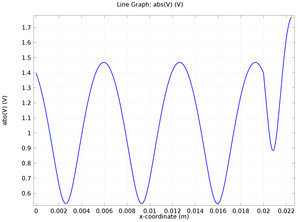
Transmission lines are used when the frequency of the electromagnetic signals is so high that the wave nature of the signals must be taken into account. A consequence of the wave nature is that the signals are reflected if there are abrupt changes of the characteristic impedance along ... Read More
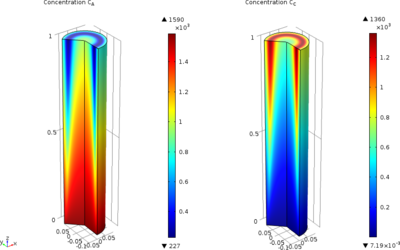
This application uses the Chemical Reaction Engineering Module to study an elementary, exothermic, irreversible reaction in a tubular reactor (liquid phase, laminar flow regime). To keep its temperature down, the reactor uses a cooling jacket with a constant coolant temperature. The ... Read More
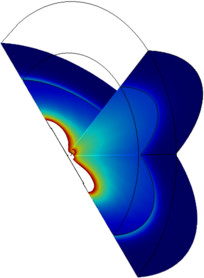
Feeding antennas with proper signals can be difficult. The signal is often described as a voltage, and voltages are not well defined in electromagnetic wave formulations. There are several tricks to model voltage generators in such situations, and one is the magnetic frill. This model ... Read More
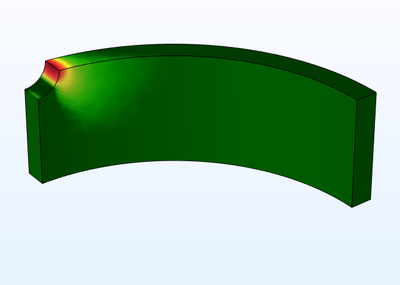
A load carrying component of a structure is subjected to multi-axial cyclic loading during which localized yielding of the material occurs. In this model you perform a low cycle fatigue analysis of the part based on the Smith-Watson-Topper (SWT) model. Due to localized yielding, you ... Read More
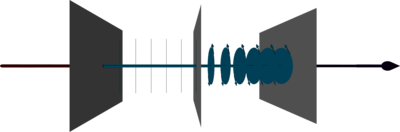
Combinations of optical devices such as polarizers and wave retarders can be used to control the intensity and polarization of transmitted radiation. In this tutorial, two linear polarizers with orthogonal transmission axes are used to reduce the intensity of a ray to zero. Then the ... Read More
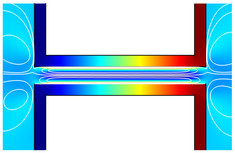
This model is a benchmark model for the Slip Flow interface. It is based on both analytic and numeric calculations. Air at atmospheric pressure flows through a conducting micro-channel connecting two reservoirs maintained at different temperatures. A flow between the two reservoirs ... Read More
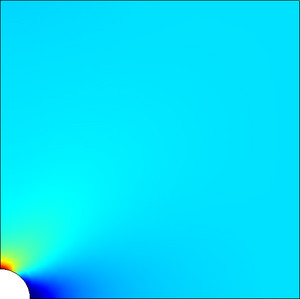
This model describes a static stress analysis to obtain the stress distribution in the vicinity of a small hole in an infinite plate. The model is a classic benchmark and is described in Mechanics of Material, by D. Roylance. The stress level is then compared with the theoretical values. Read More
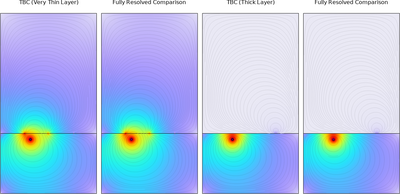
In electromagnetic simulations, such as transformers and converter stations, one often needs to include geometrically thin conductive layers. Explicitly meshing these thin layers can be computationally expensive and numerically challenging, especially when the layer thickness is much ... Read More
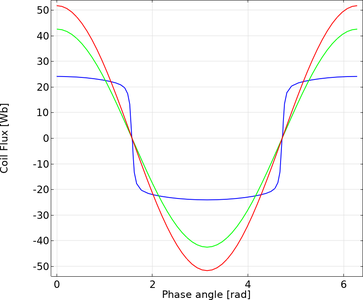
A model comparing the magnetization material models in time-dependent and frequency domain studies. Effective B-H curves are used for frequency domain. A linear relative permeability is included as reference. Read More


