
The Application Gallery features COMSOL Multiphysics® tutorial and demo app files pertinent to the electrical, structural, acoustics, fluid, heat, and chemical disciplines. You can use these examples as a starting point for your own simulation work by downloading the tutorial model or demo app file and its accompanying instructions.
Search for tutorials and apps relevant to your area of expertise via the Quick Search feature. Note that many of the examples featured here can also be accessed via the Application Libraries that are built into the COMSOL Multiphysics® software and available from the File menu.
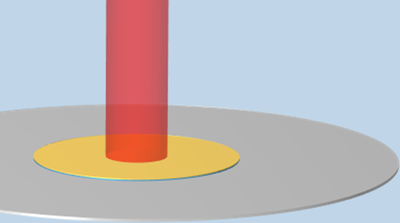
The following model demonstrates the usage of the Radiative Beam in Absorbing Media interface for computing the heating of semitransparent materials. Specifically, the model analyzes how a Gaussian profile laser beam heats two different semitransparent materials deposited onto a silicon ... Read More
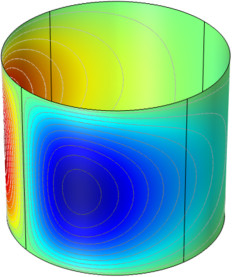
Journal bearings are used to carry radial loads, for example, to support a rotating shaft. A simple journal bearing consists of two rigid cylinders. The outer cylinder (bearing) wraps the inner rotating journal (shaft). The new thin-film flow user interfaces of the CFD Module enables ... Read More
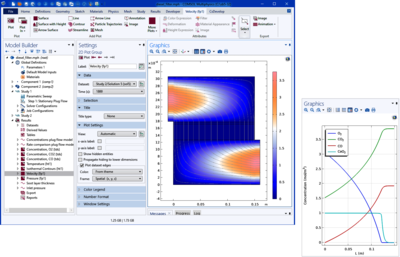
In this tutorial, a filter system for a diesel engine is modeled, including a soot layer development and oxidization. The build-up of the layer is held in check by both catalytic and non-catalytic reactions, where carbon is oxidized to carbon monoxide and carbon dioxide, which in turn ... Read More
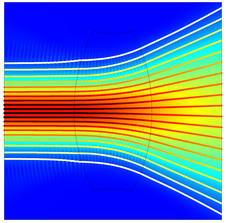
This example demonstrates how to set up a spatially varying dielectric distribution. Here, a convex lens shape is defined via a known deformation of a rectangular domain. The dielectric distribution is defined on the undeformed, original rectangular domain and is mapped onto the deformed ... Read More
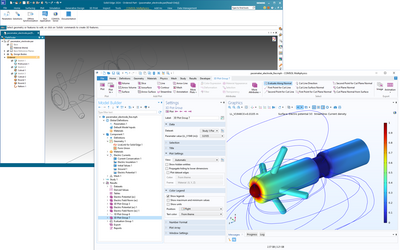
This model, dealing with the current and potential distribution around one pair of electrodes, demonstrates how to synchronize and modify geometry in Solid Edge® by using the LiveLink™ interface with a parametric sweep. Read More
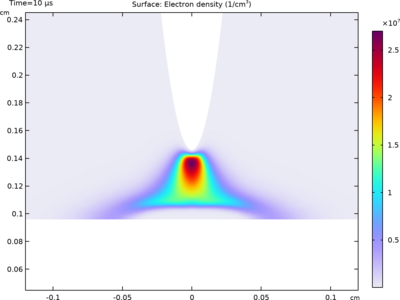
This model simulates a negative dielectric barrier discharge under a point-to-plate electrode configuration. Two solid dielectric layers are inserted into the air gap. A negative voltage of 2.5 kV is applied to the cathode electrode, initiating a corona streamer that propagates and ... Read More
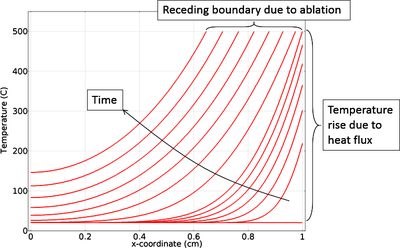
This example exemplifies how to model thermal ablation by taking into account material removal. A more detailed description of the phenomenon and the modeling process can be seen in the blog post "Modeling Thermal Ablation for Material Removal". Read More
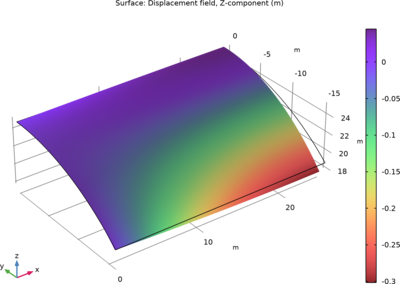
In this example a thin curved membrane is built and solved using the Shell interface. This model is a widely used benchmark model denoted the Scordelis-Lo roof. The computed maximum z-deformation is compared with the value given in Proposed Standard Set of Problems to Test Finite ... Read More
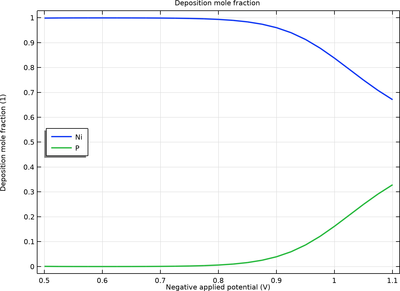
Electrochemical codeposition is a common low-cost method for producing metal alloys. This tutorial model demonstrates electrodeposition of a nickel (Ni)–phosphorous (P) alloy. The model accounts for charge and mass transport of a multitude of species along with multiple electrode ... Read More
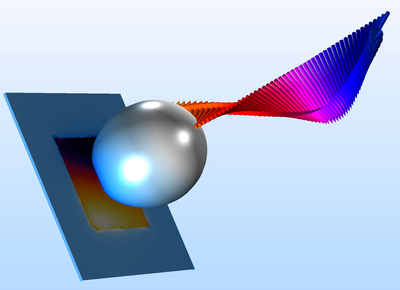
One way to generate circular polarization from a microstrip patch antenna is to truncate the patch radiator. This model is tuned around the GPS frequency range. The axial ratios are calculated to show the degree of circular polarization. Read More


