
The Application Gallery features COMSOL Multiphysics® tutorial and demo app files pertinent to the electrical, structural, acoustics, fluid, heat, and chemical disciplines. You can use these examples as a starting point for your own simulation work by downloading the tutorial model or demo app file and its accompanying instructions.
Search for tutorials and apps relevant to your area of expertise via the Quick Search feature. Note that many of the examples featured here can also be accessed via the Application Libraries that are built into the COMSOL Multiphysics® software and available from the File menu.
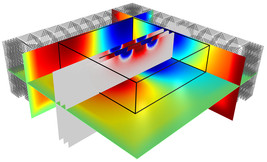
The classical forward problem of geoelectrics (includes electrical resistivity tomography, ERT and earlier techniques as vertical electric sounding, VES) is the calculation of potentials at a given set of electrodes (M,N) while current is injected at other electrodes (A,B) into the ... Read More
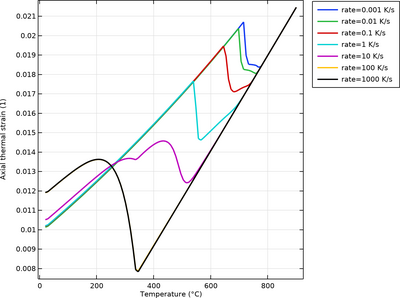
In this example, phase transformation data and phase material properties are imported from JMatPro, and used to compute CCT curves. Dilatometry curves (axial thermal strain) are computed across a range of cooling rates. Read More
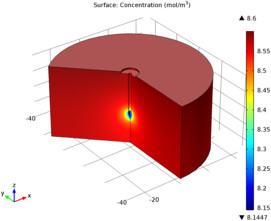
This tutorial example serves as an introduction to the Corrosion Module and models the metal oxidation and oxygen reduction current densities on the surface of a galvanized nail, surrounded by a piece of wet wood, which acts as electrolyte. The protecting zinc layer on the nail is not ... Read More
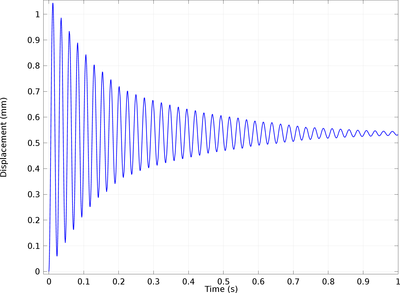
This model studies free and forced vibrations of a deep beam. Eigenfrequency, frequency response, and transient analyses are performed using a Timoshenko beam and the results are compared with analytical solutions. Read More
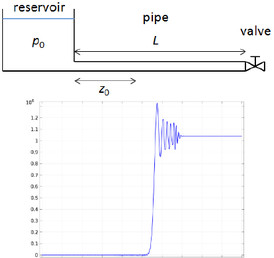
When a valve is closed rapidly in a pipe network it gives rise to a hydraulic transient known as a water hammer. The propagation of these hydraulic transients can in extreme cases cause failures of pipe systems caused by overpressures. This is a model of a simple verification pipe system ... Read More
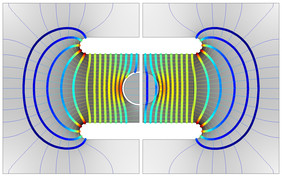
The thin low permittivity gap boundary condition is meant to approximate a thin layer of material with low relative permittivity compared to its surroundings. This boundary condition is available for electrostatic field modeling. This example compares the thin low permittivity gap ... Read More

We have all noticed the Doppler effect when an ambulance passes by with its sirens blaring. The siren’s pitch suddenly drops the moment the ambulance starts moving away from you. Another effect you can notice is how the siren’s sound is very loud when nearby, but as soon as the ... Read More

The models simulate the working mechanism of traveling wave thermoacoustic engines. Similary to the standing wave engines, the traveling wave engines make use of the coupling between the fluid motion and the temperature change experienced by the fluid to generate acoustic energy. ... Read More


