
The Application Gallery features COMSOL Multiphysics® tutorial and demo app files pertinent to the electrical, structural, acoustics, fluid, heat, and chemical disciplines. You can use these examples as a starting point for your own simulation work by downloading the tutorial model or demo app file and its accompanying instructions.
Search for tutorials and apps relevant to your area of expertise via the Quick Search feature. Note that many of the examples featured here can also be accessed via the Application Libraries that are built into the COMSOL Multiphysics® software and available from the File menu.
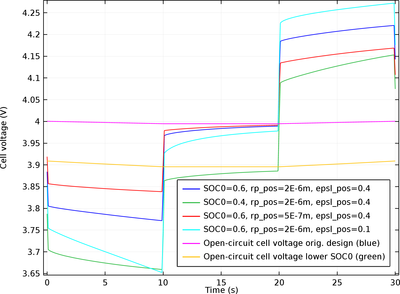
This tutorial digs deeper into the investigation of rate capability in a battery and shows how the Lithium-Ion Battery interface is an excellent modeling tool for doing this. The rate capability is studied in terms of polarization (voltage loss) or the internal resistance causing this ... Read More

This model demonstrates how to setup a Time Domain to Frequency FFT study for a distributed Bragg reflector (DBR) structure. The results agree well with the results of a regular Frequency domain study. Read More
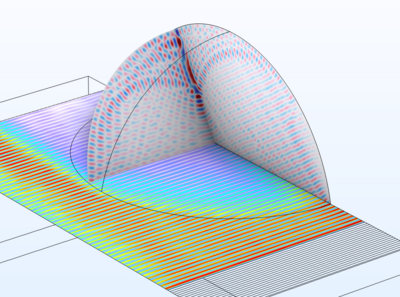
When a droplet is placed on a substrate on which surface acoustic waves (SAWs) are traveling, the energy of the SAWs is transferred into the droplet to form an acoustic field. The transferred energy is attenuated and generates a streaming flow. This type of streaming enables contactless ... Read More
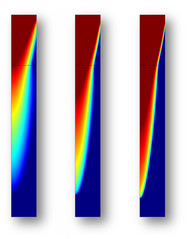
This example is a model of a continuous casting process. Liquid metal is poured into a mold of uniform cross section. The outside of the mold is cooled and the metal solidifies as it flows through. When the metal leaves the mold, it is completely solidified on the outside, but still ... Read More
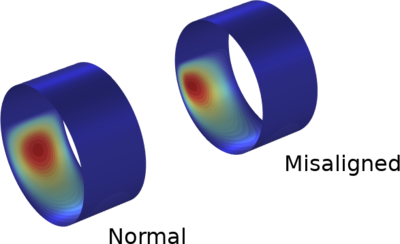
In this example, a rotor supported on two hydrodynamic bearings is analyzed. An eccentric disk located between the two bearings causes the rotor to whirl. One of the bearings is misaligned with the axis of the rotor. The Beam Rotor with Hydrodynamic Bearing interface in the ... Read More
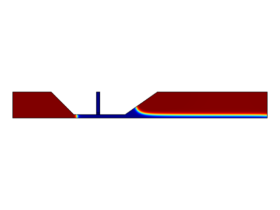
This tutorial shows how to model a slot die coating process with a power-law non-Newtonian fluid in one of the two phases. The model uses a two-phase flow phase-field method. Read More

This example presents a homogenized model of a corrugated sheet based on a unit cell approach. The numerically obtained equivalent stiffness matrices are compared with various analytical models. Two corrugation profiles, trapezoidal and round, are considered in this example. Read More
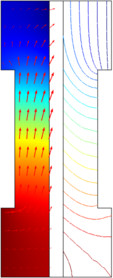
This example focuses on the species transport within the gas diffusion layers (GDLs) of a proton exchange membrane (PEM) fuel cell. The geometry models a cell with two adjacent flow channels of different pressures, a situation that may occur in a cell with serpentine flow channels, or in ... Read More
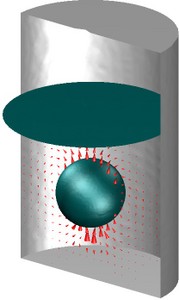
The level set method is well suited for problems with moving boundaries in which the geometry’s topology changes with time. A bubble of oil that travels up through water and finally merges with oil at the top causes this kind of topology change. For problems where the topology is ... Read More
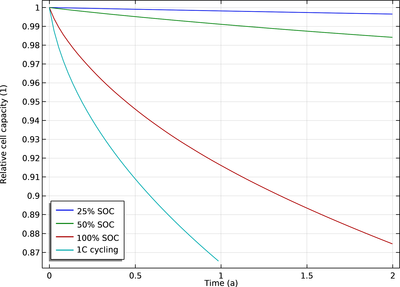
This tutorial demonstrates the Lumped Battery interface for modeling capacity loss in a battery. A set of lumped parameters are used to describe the capacity loss that occurs due to parasitic reactions in the battery, assuming no knowledge of the internal structure or design of the ... Read More


