
The Application Gallery features COMSOL Multiphysics® tutorial and demo app files pertinent to the electrical, structural, acoustics, fluid, heat, and chemical disciplines. You can use these examples as a starting point for your own simulation work by downloading the tutorial model or demo app file and its accompanying instructions.
Search for tutorials and apps relevant to your area of expertise via the Quick Search feature. Note that many of the examples featured here can also be accessed via the Application Libraries that are built into the COMSOL Multiphysics® software and available from the File menu.
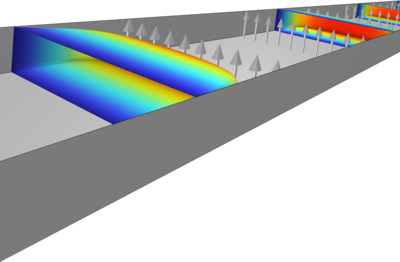
In nuclear fusion reactors, the conducting fluid, such as the fusion plasma and the liquid metal in the reactor blanket, will interact with the background magnetic field. This phenomenon is referred to as magnetohydrodynamics (MHD). The electromagnetic field and fluid flow are fully ... Read More

This example describes the cooling and solidification, from melt to solid metal, in a continuous casting process. The model includes nonisothermal properties, temperature distribution, flow field, and phase change. This example uses the arbritrary Lagrangian-Eulerian method for modeling ... Read More
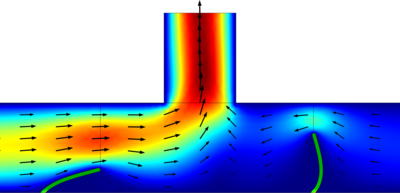
Micropumps are key components of microfluidic systems with applications ranging from biological fluid handling to microelectronic cooling. This model simulates the mechanism of a valveless micropump, that is designed to be effective at low Reynolds numbers, overcoming hydrodynamic ... Read More
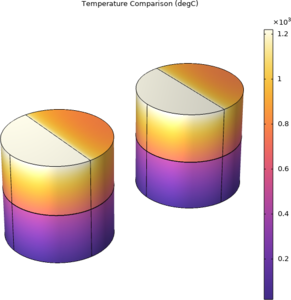
This example is a variant of the Composite Thermal Barrier tutorial and shows how to set up multiple sandwiched thin layers with different thermal conductivities in two different ways. First, the composite is modeled as a 3D object. In the second approach the Lumped Thermal System ... Read More
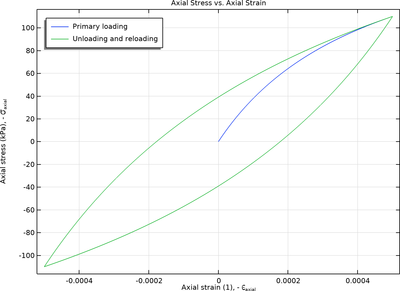
The small strain overlay material model captures the effect of high stiffness at low strain as well as the hysteresis under cyclic loading, which is a common effect for most soils. The formulation allows stiffness degradation with an increase in shear strain, and the full recovery of ... Read More
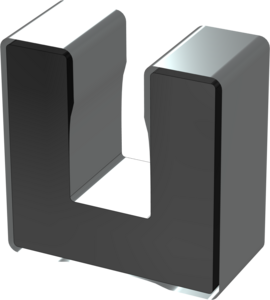
This model analyzed the ALD deposition process of alumina film on the surface of a U-shaped structure. In this process, gaseous precursors are sequentially introduced to the reaction chamber and sequentially undergo a series of adsorption and chemical reactions on the surface. The ... Read More
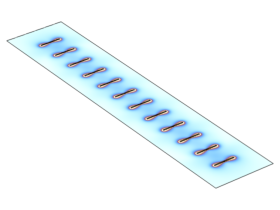
This example of a dipole antenna array demonstrates a cost-effective analysis using the Boundary Element Method (BEM). When dealing with a large array made of metallic radiators, the Finite Element Method (FEM) would necessitate greater computational resources. The simulation results ... Read More
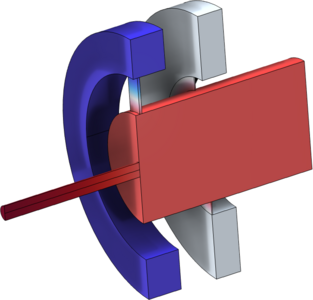
This model computes the input impedance/admittance to an acoustic system in the frequency domain. The system here represents a typical measurement setup used for testing hearing aids and includes domains with thermoviscous boundary layer losses. The input admittance, computed in the ... Read More
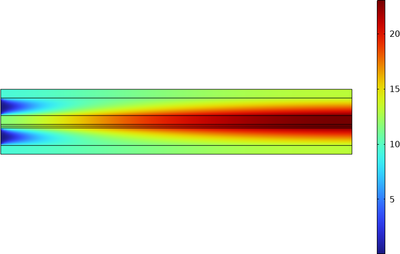
This example models co-electrolysis of H2O and CO2 using a solid oxide electrolyzer cell. The model includes the full coupling between the mass balances and gas flow in the H2 and O2 gas diffusion electrodes, the momentum balances in the H2 and O2 gas flow channels, the energy balance ... Read More
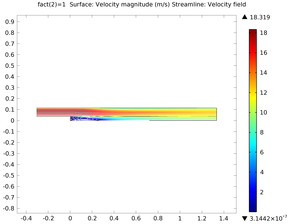
The backward facing step is an interesting case for studying the performance and solution strategy of a turbulence model. In this case, the flow is subjected to a sudden increase of cross-sectional area, resulting in a separation of flow starting at the point of expansion. Spatial ... Read More


