
The Application Gallery features COMSOL Multiphysics® tutorial and demo app files pertinent to the electrical, structural, acoustics, fluid, heat, and chemical disciplines. You can use these examples as a starting point for your own simulation work by downloading the tutorial model or demo app file and its accompanying instructions.
Search for tutorials and apps relevant to your area of expertise via the Quick Search feature. Note that many of the examples featured here can also be accessed via the Application Libraries that are built into the COMSOL Multiphysics® software and available from the File menu.
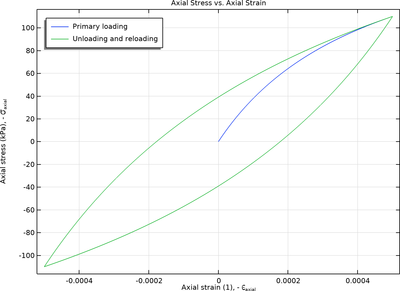
The small strain overlay material model captures the effect of high stiffness at low strain as well as the hysteresis under cyclic loading, which is a common effect for most soils. The formulation allows stiffness degradation with an increase in shear strain, and the full recovery of ... Read More
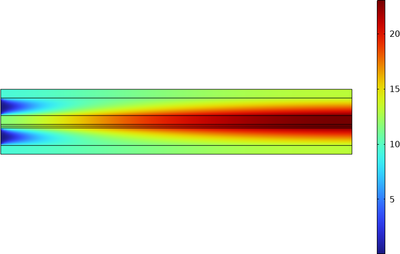
This example models co-electrolysis of H2O and CO2 using a solid oxide electrolyzer cell. The model includes the full coupling between the mass balances and gas flow in the H2 and O2 gas diffusion electrodes, the momentum balances in the H2 and O2 gas flow channels, the energy balance ... Read More
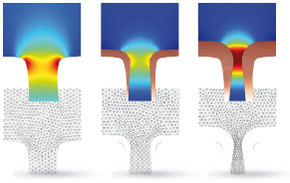
This model demonstrates the use of moving meshes in the application of copper electrodeposition on circuit boards. In these environments, the presence of cavities or 'trenches' are apparent. The model makes use of the Tertiary, Nernst-Planck interface for electrodeposition to keep track ... Read More
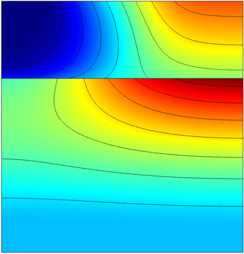
In this example water ponded in a ring on the ground moves into a relatively dry soil column and carries a chemical with it. As it moves through the variably saturated soil column, the chemical attaches to solid particles, slowing the solute transport relative to the water. Additionally ... Read More
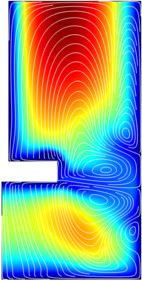
Swirl flow is an application that involves steady rotational flow around an axis. Rather than modeling this process in 3D, COMSOL Multiphysics provides a 2D axisymmetric interface where the flow in the rotational direction is still included in the equations. This example shows the ... Read More
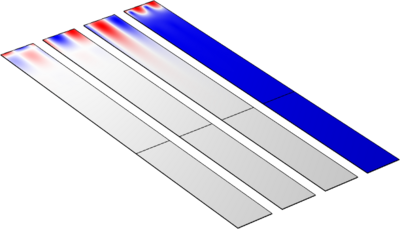
In the surface acoustic waves industry different crystal cuts of piezoelectric materials are used, e.g. 128ᵒ YX LiNbO3, AT&ST quartz, 42ᵒ YX LiTaO3, etc. Direct data isn’t available for all cuts. The standard approach is to use the so-called Euler angle rotation. COMSOL supports it ... Read More
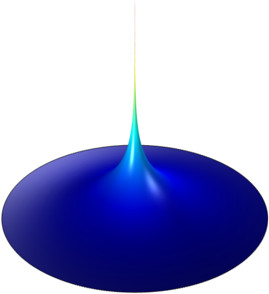
This model solves Poisson's equation on a unit disk with a point source at the origin. The mesh density is higher close to the origin to resolve the singularity. The computed solution is compared to the analytical solution. Read More
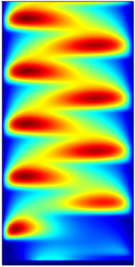
This model simulates electrical breakdown in an atmospheric pressure gas. Modeling dielectric barrier discharges in more than one dimension is possible, but the results can be difficult to interpret because of the amount of competing physics in the problem. In this simple model the ... Read More

This tutorial model solves for a one-dimensional capacitively coupled plasma reactor in a mixture of argon/oxygen. Important aspects and strategies for modeling electronegative discharges are discussed. Read More
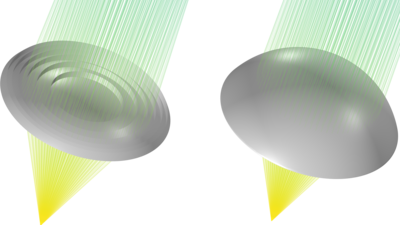
A Fresnel lens can be constructed from a plano-convex lens as a way to reduce the thickness. This model models the collimation property of a Fresnel lens and demonstrates the geometry operation of making a Fresnel lens from a plano-convex lens. Read More


