
The Application Gallery features COMSOL Multiphysics® tutorial and demo app files pertinent to the electrical, structural, acoustics, fluid, heat, and chemical disciplines. You can use these examples as a starting point for your own simulation work by downloading the tutorial model or demo app file and its accompanying instructions.
Search for tutorials and apps relevant to your area of expertise via the Quick Search feature. Note that many of the examples featured here can also be accessed via the Application Libraries that are built into the COMSOL Multiphysics® software and available from the File menu.
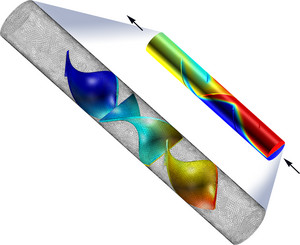
In static mixers, also called motionless or in-line mixers, a fluid is pumped through a pipe containing stationary blades. This mixing technique is particularly well suited for laminar flow mixing because it generates only small pressure losses in this flow regime. This example studies ... Read More
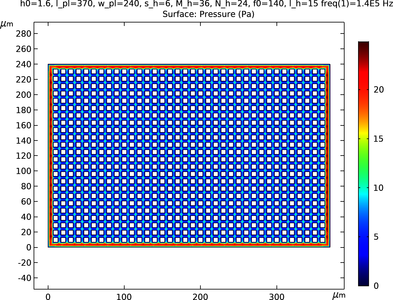
This benchmark model compares the damping coefficients of perforated plates from computation results versus experimental data. The simulation includes 18 different geometric configurations. It uses the Bao's perforation model, which is built-in in the Thin Film Flow physics interface. ... Read More
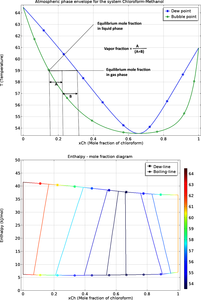
This is a demonstration of how to use the thermodynamics functionality in the COMSOL Multiphysics® software to make flash calculations. A flash calculation is an equilibrium calculation of a system where several species and phases are present at the same time. The system in ... Read More
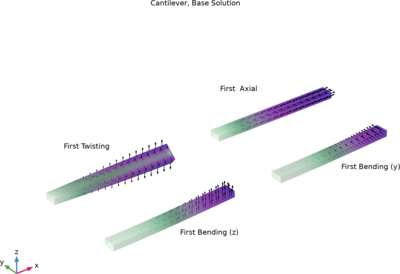
This example explores the shift in natural frequencies caused by changing the temperature. One study investigates a doubly clamped beam where both ends are fixed, while the other study looks at a cantilever beam where only one end is fixed. The following effects are studied: Stress ... Read More
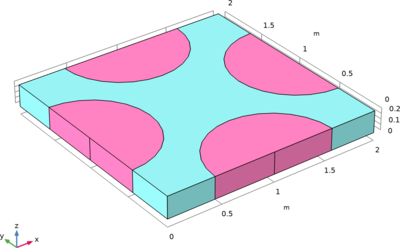
In this example, the micromechanical properties of a piezoelectric fiber composite are studied. The homogenized electromechanical properties of the composite are derived from the individual microscopic properties of matrix and fiber. Read More
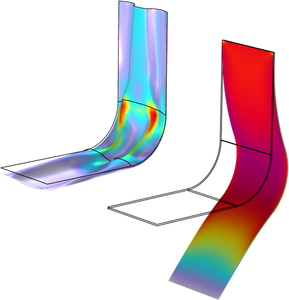
This model demonstrates how to use the Free Shape Shell feature to increase the stiffness of a shell by deforming its shape. Read More
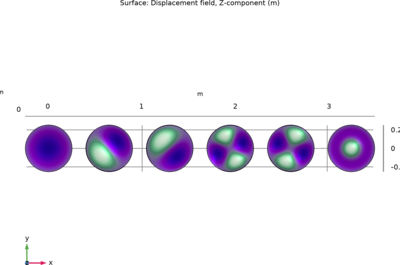
This example studies the natural frequencies of a pretensioned membrane exhibiting stress stiffening. The model results are compared with the analytical solution. Two different techniques for generating the prestress are explored. Read More
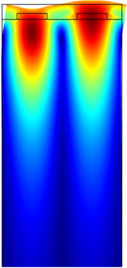
A surface acoustic wave (SAW) is an acoustic wave propagating along the surface of a solid material. Its amplitude decays rapidly, often exponentially, through the depth of the material. SAWs are utilized in many kinds of electronic components, including filters, oscillators, and ... Read More

This example illustrates the principle of electrochemical polishing. The simplified 2D model geometry consists of two electrodes and an intermediate electrolyte domain The positive electrode has a protrusion, representing a surface defect. The purpose of the model is to examine how this ... Read More
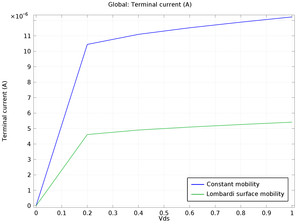
Surface acoustic phonons and surface roughness have an important effect on the carrier mobility, especially in the thin inversion layer under the gate in MOSFETs. The Lombardi surface mobility model adds surface scattering resulting from these effects to an existing mobility model using ... Read More


