
The Application Gallery features COMSOL Multiphysics® tutorial and demo app files pertinent to the electrical, structural, acoustics, fluid, heat, and chemical disciplines. You can use these examples as a starting point for your own simulation work by downloading the tutorial model or demo app file and its accompanying instructions.
Search for tutorials and apps relevant to your area of expertise via the Quick Search feature. Note that many of the examples featured here can also be accessed via the Application Libraries that are built into the COMSOL Multiphysics® software and available from the File menu.
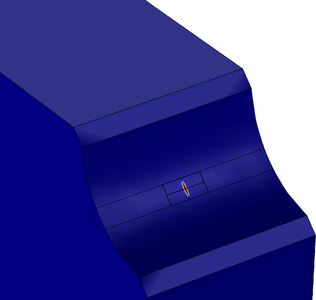
When a linear guide is loaded above the manufacturer's specification limit, one concern is whether the contact loads will introduce fatigue spalling. In this system analysis, the entire guide has been analyzed and the mostly damaging contact load has been identified to occur on a rail ... Read More
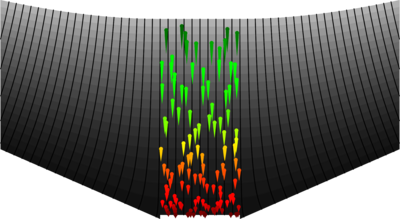
An electron gun must be able to draw a sufficient current and accelerate the electrons to the desired speed. The first part of an electron gun geometry presents unique design challenges because the emitted electron speeds are usually lowest there, and therefore the space charge density ... Read More

This model analyzes the thermal expansion in a MEMS device, such as a microgyroscope, where thermal expansion should be minimized. The device is made from the copper-beryllium alloy UNS C17500 and uses temperature-dependent material properties from the Material Library. The purpose of ... Read More
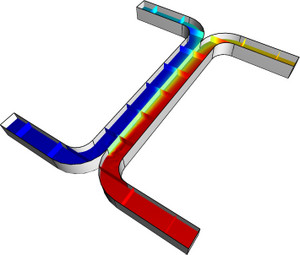
This example was originally formulated by Albert Witarsa under Professor Bruce Finlayson’s supervision at the University of Washington in Seattle. It was part of a graduate course in which the assignment consisted of evaluating the potential of patents in the field of microfluidics ... Read More
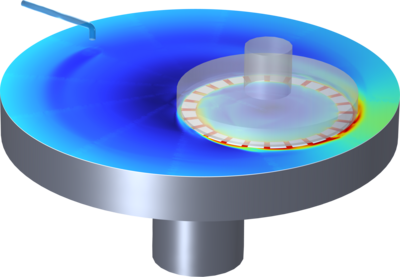
Chemical mechanical polishing (CMP) is a crucial technique for surface planarization, widely used in semiconductor fabrication and optical device manufacturing. This model simulates the flow field within the CMP retaining ring and tracks the motion of abrasive particles carried by the ... Read More

This model uses the Optimization interface to solve the inverse problem for determining the spatially variable hydraulic conductivity on a discretized quadratic grid from a number of aquifer pump tests. Because the number of observations is smaller than the number of unknown parameters, ... Read More
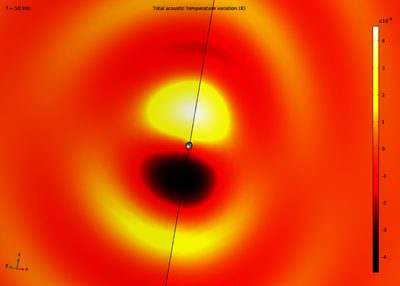
This tutorial simulates a small vibrating hemispherical particle in water. The particle has a radius of 1 mm and is oscillating in the axial direction at a frequency of 50 kHz. The vibrations induce acoustic waves in the fluid. The example demonstrates how to set up a thermoviscous ... Read More
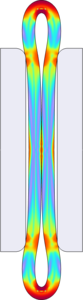
In offshore applications, it is sometimes necessary to quickly seal a pipe as part of the prevention of a blowout. This example shows a simulation, in which a circular pipe is squeezed between two flat stiff indenters until it is almost flat. The model serves as an example of an analysis ... Read More
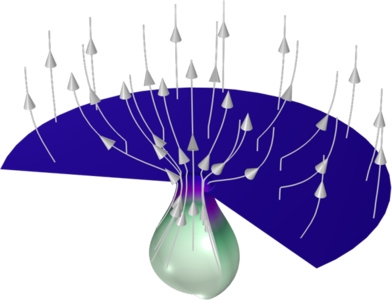
Pitting corrosion is a type of localized corrosion by which local cavities, pits, are formed on an initially smooth metal surface. A pit may be initialized by surface defects, such as an inhomogeneities in composition or shape, or mechanical abuse resulting in a small scratch or dent. ... Read More
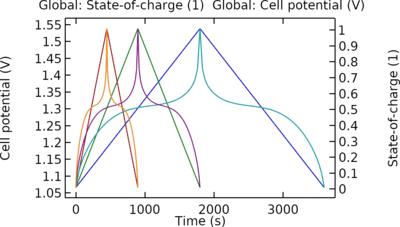
A simple equivalent circuit model approach is presented for Nickel metal hydride batteries. The 0D model consists of resistor, capacitor, current source and state-of-charge based voltage source (SOC). An Arrhenius type dependence is used to account for self-discharge. All model ... Read More


