
KAPL Analyzes CO2 Foil Thrust Bearing Characteristics with Simulation
Treevor Munroe
Knolls Atomic Power Laboratory, Niskayuna, NY
Knolls Atomic Power Laboratory (KAPL) is a research and development facility supporting the United States Naval Nuclear Propulsion Program. KAPL recently collaborated with Bettis Atomic Power Laboratory to test a supercritical carbon dioxide (S-CO2) Brayton power cycle system.
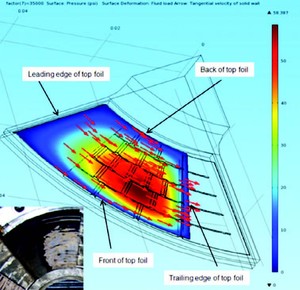
The system was designed to operate at high speed and high gas pressure, which means the turbine shaft bearings must withstand a wide range of radial and axial loads. The thrust bearings used to constrain the axial forces, however, showed extensive wear at certain speeds.
Using COMSOL Multiphysics, KAPL was able to analyze the structural mechanics, fluid mechanics, and heat transfer of the Brayton power cycle system to better understand the operation and deterioration of the thrust bearings. This allowed them to optimize geometry and to improve bearing performance.
Suggested Stories
Keynote: Using COMSOL Multiphysics® for Circuit Board Thermal Analysis
The aerospace and defense industry requires stronger circuit boards than those needed for everyday electronics due to ...
Multiphysics Analysis of CO2 Foil Thrust Bearing Characteristics
Knolls Atomic Power Laboratory (KAPL) is a research and development facility supporting the United States Naval ...
Designing Next-Generation CO2 Removal Technology for Better Life in Space
NASA combines thermal modeling and experimental testing to find the best compressor design for the system that keeps ...
The Sound of Perfection Thanks to the Modeling of Acoustic Metasurfaces
At the École Polytechnique Fédérale de Lausanne (EPFL), engineers have designed an acoustic metasurface that could be ...


