
The Application Gallery features COMSOL Multiphysics® tutorial and demo app files pertinent to the electrical, structural, acoustics, fluid, heat, and chemical disciplines. You can use these examples as a starting point for your own simulation work by downloading the tutorial model or demo app file and its accompanying instructions.
Search for tutorials and apps relevant to your area of expertise via the Quick Search feature. Note that many of the examples featured here can also be accessed via the Application Libraries that are built into the COMSOL Multiphysics® software and available from the File menu.
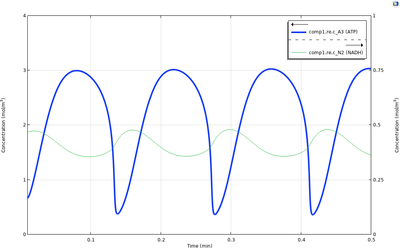
Oscillating chemical reactions were long thought to simply not exist in homogeneous solution, and even the poster child, the Belousov–Zhabotinsky reaction, met such an initial skepticism, that even though it was discovered in 1951, it took almost 20 years for it to gain widespread fame. ... Read More

This application demonstrates how you can access and include external thermodynamic and physical property calculations in your simulation, using the Thermodynamics feature. The example shows how you can easily modify the predefined Plug-flow reactor type in the Reaction Engineering ... Read More
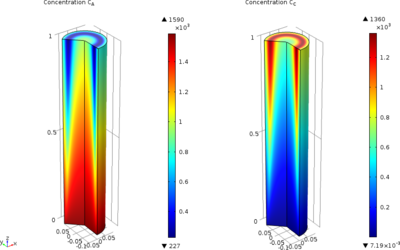
This application uses the Chemical Reaction Engineering Module to study an elementary, exothermic, irreversible reaction in a tubular reactor (liquid phase, laminar flow regime). To keep its temperature down, the reactor uses a cooling jacket with a constant coolant temperature. The ... Read More
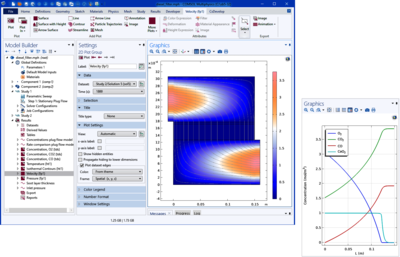
In this tutorial, a filter system for a diesel engine is modeled, including a soot layer development and oxidization. The build-up of the layer is held in check by both catalytic and non-catalytic reactions, where carbon is oxidized to carbon monoxide and carbon dioxide, which in turn ... Read More
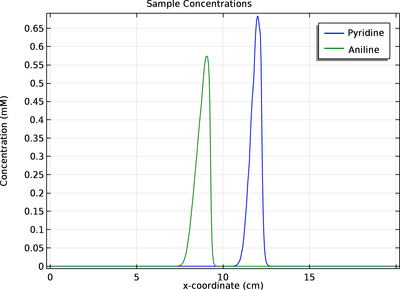
Zone electrophoresis (ZE) is an electrophoretic separation technique typically used for analyzing proteins, nucleic acids, and biopolymers. During the process, different species in a sample are transported in a continuous electrolyte buffer system, subject to a potential gradient. Due to ... Read More
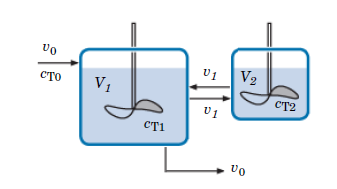
Real reactors can be modeled as combinations of ideal reactors. In this example the so-called "Dead zone model" is utilized. Two ideal CSTRs with interchange are set up to model the real reactor. One CSTR represents the highly agitated region and the other the less agitated region. For ... Read More
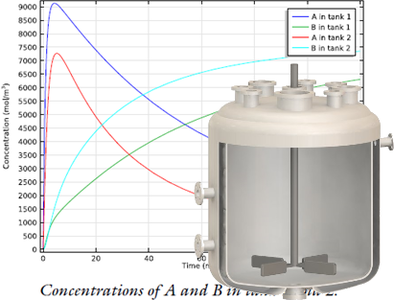
In the chemical and biochemical industries, for instance in fermentation processes, reactors having well-mixed conditions and liquid level control are common. This example shows modeling of a 0D ideal system of tank reactors in series with controlled feed inlet and product outlet ... Read More
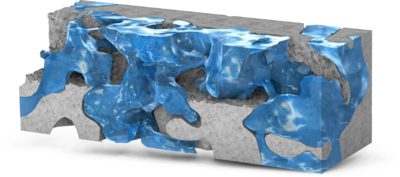
Digital Rock technology utilizes high-resolution imaging techniques, such as SEM and X-ray CT, to characterize the pore structures of rock cores. This approach enables pore-scale modeling of reservoir rocks, offering valuable insights into pore morphology, connectivity, and fluid ... Read More
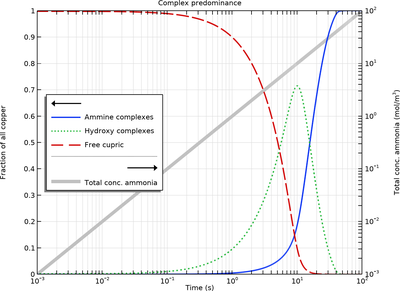
Cupric ions show a strong affinity to ammonia in aqueous solutions, forming strongly colored deep blue complexes. The relative amounts of the different ammine ligand complexes, with varying coordination numbers, are governed by the stability constants of the equilibria forming the ... Read More
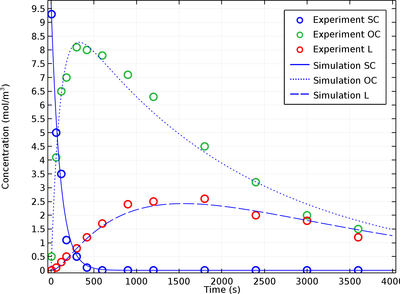
Biotechnology is a rapidly growing area in the pharmaceutical sciences. One example of a clinical application is gene therapy, where it is possible to produce proteins in vivo, using the body’s own mechanisms for protein production. Major issues in gene delivery involve the transport of ... Read More


