
The Application Gallery features COMSOL Multiphysics® tutorial and demo app files pertinent to the electrical, structural, acoustics, fluid, heat, and chemical disciplines. You can use these examples as a starting point for your own simulation work by downloading the tutorial model or demo app file and its accompanying instructions.
Search for tutorials and apps relevant to your area of expertise via the Quick Search feature. Note that many of the examples featured here can also be accessed via the Application Libraries that are built into the COMSOL Multiphysics® software and available from the File menu.
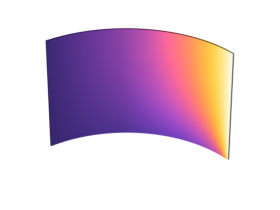
This model simulates a static analysis of heat conduction in a thin conductive shell. This is a benchmark model where the result is compared with a NAFEMS benchmark solution. Read More
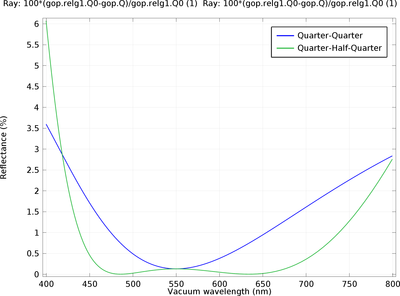
Anti-reflective coatings are frequently used in optical systems to reduce the amount of stray light produced when a beam of light crosses from one medium into another medium with a different refractive index. The simplest example of an anti-reflective coating is a quarter-wavelength ... Read More
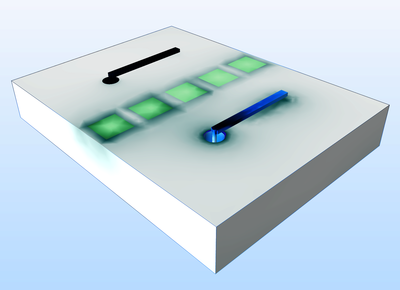
An Electromagnetic Band Gap (EBG) structure can be used to increase the isolation between antennas close to each other. The decoupling effect is not only a function of frequency but also polarization and coupling-plane configuration. When designing an EBG structure, one needs to make ... Read More
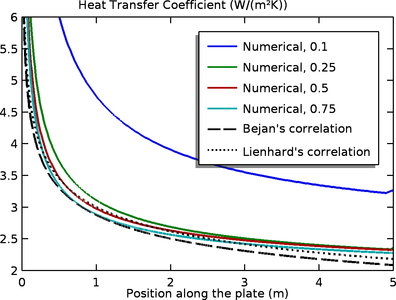
This verification model of nonisothermal turbulent flow over a flat plate compares the heat transfer coefficient obtained from simulation with theoretical values based on Nusselt number correlation functions that can be found in the literature. Read More
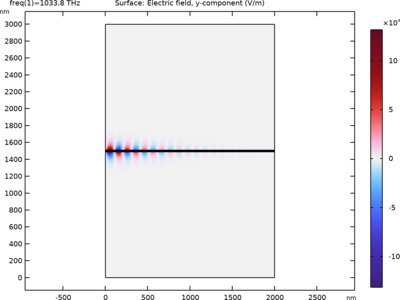
This model demonstrates how to simulate surface plasmon polaritons in a thin metal layer embedded in dielectric layers. It calculates the dispersion and propagation length of surface plasmon polaritons as a function of photon energy. Read More
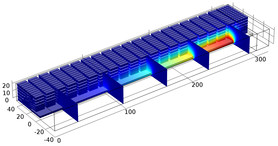
The elastic cantilever beam is one of the elementary structures used in MEMS designs. This model shows the bending of a cantilever beam under an applied electrostatic load. The model solves the deformation of the beam under an applied voltage. Read More
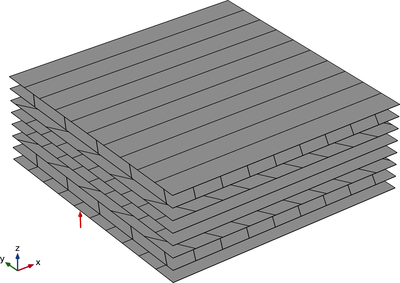
This model serves the purpose of validation and verification of the Linear Elastic Material, Layered model in the Shell interface. In COMSOL Multiphysics, composites are analyzed either based on Layerwise 3D elasticity theory through the Layered Shell interface or based on FSDT-ESL ... Read More
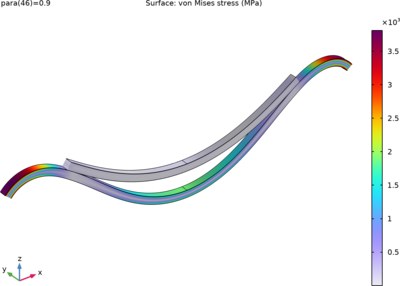
This conceptual example shows how to calculate critical points in models with contact. The model consists of two contacting arches modeled with the Shell interface. The contact problem is solved using the penalty method. The upper arch is loaded with displacement controlled edge loads ... Read More
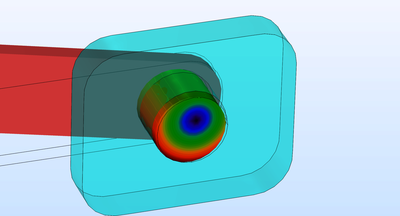
Clearance between connected components is often introduced to facilitate assembly and allow relative motion. However, clearance in joints can generate impact forces that adversely affect system performance and lead to noise and vibration. This model compares the dynamic behavior of a ... Read More
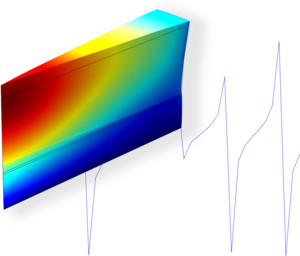
This example shows how to set up a piezoelectric transducer problem following the work of Y. Kagawa and T. Yamabuchi. The composite piezoelectric ultrasonic transducer has a cylindrical geometry that consists of a piezoceramic layer, two aluminum layers, and two adhesive layers. The ... Read More


