Material Library

Access 18,806 Materials with up to 49 Key Properties Each

With COMSOL Multiphysics®, users have complete control over the definitions and use of the material properties of their models. The Material Browser can be used to manage models' materials in one place, and the Model Builder can be used to manage and customize the materials in COMSOL® simulations. By adding the Material Library to the platform product, users gain access to a large library of material properties. The library contains data for 18,806 materials — including elements, minerals, metal alloys, thermal insulators, semiconductors, piezoelectric materials, and more.

Each material has up to 49 key property functions, each dependent on a variable (most often temperature). Users can plot and inspect the definitions of these functions as well as add to and alter them. The functions can also be used in any physics simulation couplings that depend on the material properties in multiphysics models. The Material Library also provides references for the material properties data it contains.

Contact COMSOL
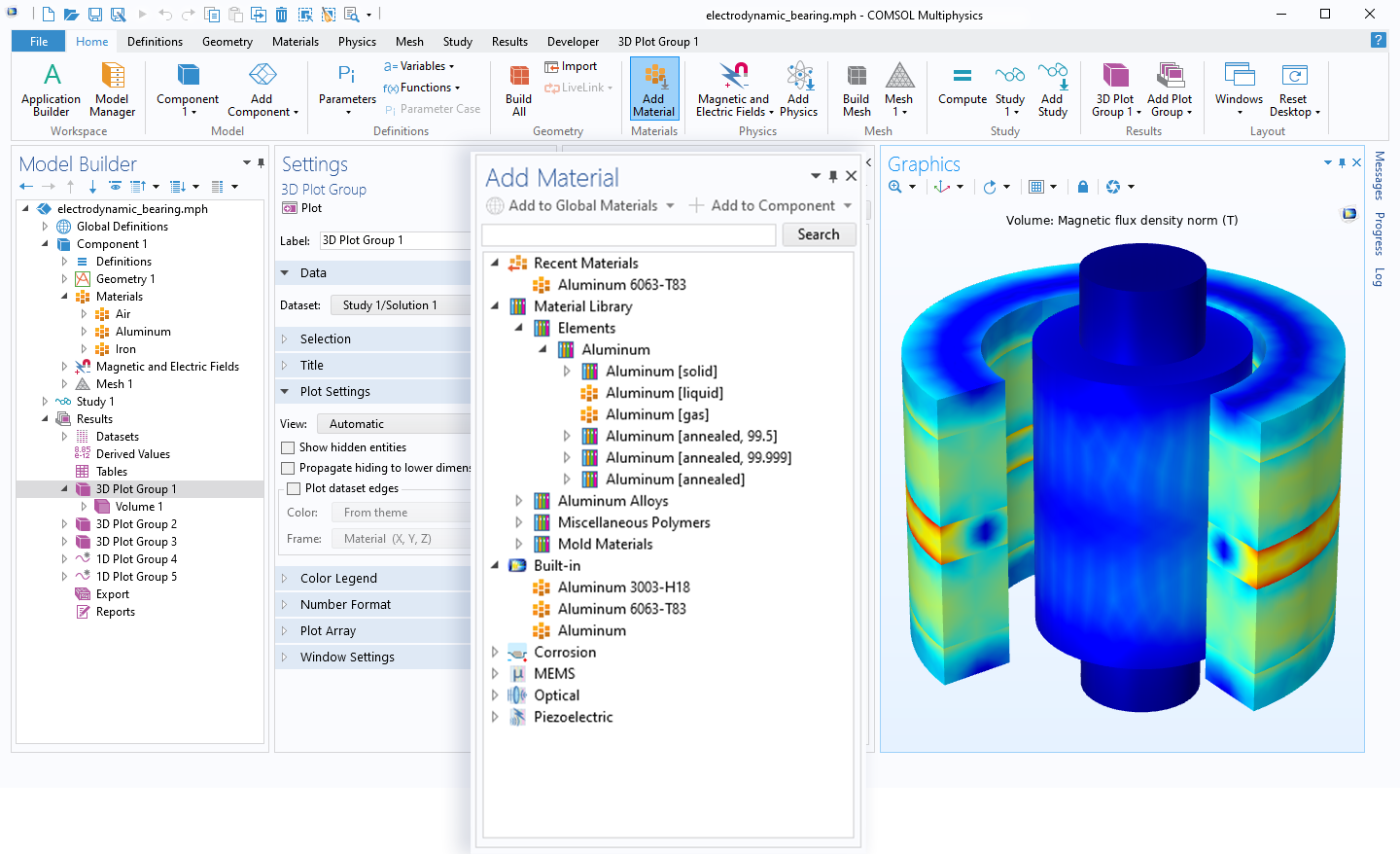
The COMSOL Multiphysics UI showing the Add Material window and an electrodynamic bearing model in the Graphics window.

Available Materials

The following classes of materials are included in the Material Library:

  • The elements
  • Fe and Ni alloys
  • Al and Cu alloys
  • Mg and Ti alloys
  • Zn and precious metal alloys
  • Oxides
  • Carbides, cermets, and tool steels
  • Carbons and thermal insulators
  • Intermetallics, thermal coatings, refractory metal alloys, and high-entropy and equiatomic alloys
  • Nylons, polyamides, polyethers, and polyesters
  • Acetal, PVDF, and EVA
  • Elastomers and epoxies
  • Miscellaneous polymers and polymer composites
  • Minerals, rocks, soils, and woods
  • Polypropylenes, PET, PBT, ECTFE, PFA, and ETFE
  • Zinc and thermocouple alloys
  • Solders, brazes, and low melting alloys
  • Semiconductors and optical materials
  • Organics, hydrocarbons, and lubricants Foods
  • Cobalt, resistance, and magnetic alloys
  • Metal matrix and ceramic matrix composites
  • Salts
  • Electroceramics
  • Silicides and borides
  • Glasses, metallic glasses, and nitrides
  • Cast irons and mold materials
  • Circuit boards and antenna substrates
  • Epoxies, acrylics, and PMMA
  • Structural foams
  • Fluorides
  • Precious metals and rare earth alloys
  • Acids
  • Other materials (such as air, seawater, and ammonia)

About the Materials in the Material Library

The 18,806 materials in the Material Library consist of a total of 181,117 comprehensive material property datasets, representing relevant material properties for each material. Together with these material properties, are references that describe the source of the data, notes about the accuracy of the property values, and other relevant information about the material properties. Many of the properties are defined as a function, most often of temperature, and are typically implemented as piecewise polynomial functions.

Most of the materials are available in different phases, such as solid, liquid, gas, and other material-specific phases. For many materials in the Material Library, different variations are also included, such as material properties at different operating conditions or variants of one material. For some materials, variants corresponding to different material orientations are provided.

The Material Library can be used to quickly search and browse for materials and add them to a model, either as global materials or to any model component. Materials can also be added to an existing or new user-defined library, and once the materials have been added to a model, their properties can be modified.

Module-Specific Material Libraries

In addition to the Material Library product, many of the COMSOL add-on modules include their own module-specific material libraries with predefined materials and property data. For example, the Battery Design Module provides properties for electrolytes and electrode reactions for certain battery chemistries, and the MEMS Module includes metals, semiconductors, and polymers used in microsystems. The Nonlinear Magnetic material library, included in the AC/DC Module and RF Module, contains ferromagnetic materials with B–H curves, and the Optical material library, included in the Ray Optics Module and Wave Optics Module, offers refractive index data for optical and photonic analyses.

Combining the Material Library add-on with the module-specific material libraries enables efficient model setup and realistic simulation across various applications.

Every business and every simulation need is different.

In order to fully evaluate whether or not the COMSOL Multiphysics® software will meet your requirements, you need to contact us. By talking to one of our sales representatives, you will get personalized recommendations and fully documented examples to help you get the most out of your evaluation and guide you to choose the best license option to suit your needs.

Just click on the "Contact COMSOL" button, fill in your contact details and any specific comments or questions, and submit. You will receive a response from a sales representative within one business day.

Next Step

Request a Software Demonstration